Most working professionals already know one thing.
They are not moving enough.
Long hours at a desk. Back-to-back meetings. Entire days spent sitting with barely any sustained physical activity.
It is not a lack of awareness.It is a lack of consistency.
You plan to work out. You intend to move more. You even start sometimes.
But routines break.
And once they break, getting back into rhythm becomes harder than starting.
The Problem Is Not Motivation
It is easy to assume that the solution is more discipline.
But that is rarely the issue.
The real problem lies in how your day is structured.
Work is fixed. Timelines are fixed. Responsibilities are non-negotiable.
Movement is flexible. Which is why it gets pushed.
Not because it is unimportant, but because it is not built into your system.
And anything that is not built into your system eventually becomes optional.
What Science Says About Inactivity
A sedentary lifestyle is not just about doing nothing.
It is about long periods of low movement.
According to the World Health Organization, insufficient physical activity is one of the leading risk factors for global mortality.
Research links prolonged inactivity to:
- Increased risk of cardiovascular disease
- Higher likelihood of type 2 diabetes
- Reduced metabolic function
- Lower energy and productivity levels
Even if you manage to work out occasionally, extended sitting throughout the day can reduce many of those benefits.
Consistency matters more than intensity.
Why Walking and Running Still Work
There is no shortage of complex fitness trends.
But the most effective solutions are often the simplest.
Walking, jogging, and running remain some of the most researched forms of exercise.
They require no learning curve. No complicated routines. No mental overhead.
Just movement.
Regular brisk walking can:
- Improve heart health
- Enhance circulation
- Support weight management
- Reduce stress
Jogging and running increase cardiovascular capacity and calorie burn, making them efficient even in shorter durations. The American Heart Association recommends at least 150 minutes of moderate-intensity aerobic activity per week.
That is just over 20 minutes a day.
Not extreme. Not unrealistic.
But only effective if it happens regularly.
Where Most Routines Break
If the solution is simple, why is it hard to follow?
Because consistency depends on ease.
Think about what it takes to go for a run or even a walk outside.
You check the weather. You plan your time. You adjust your schedule.
Sometimes you skip because it feels inconvenient.
These small decisions add friction.
And friction breaks habits.
The Shift From Intention to System
To stay consistent, movement needs to be built into your environment.
It should not depend on ideal conditions.
It should not require extra planning.
It should be something you can start without thinking twice.
This is where your setup starts to matter more than motivation.
Bringing Movement Closer to You
One of the simplest ways to reduce friction is to remove dependency on external factors.
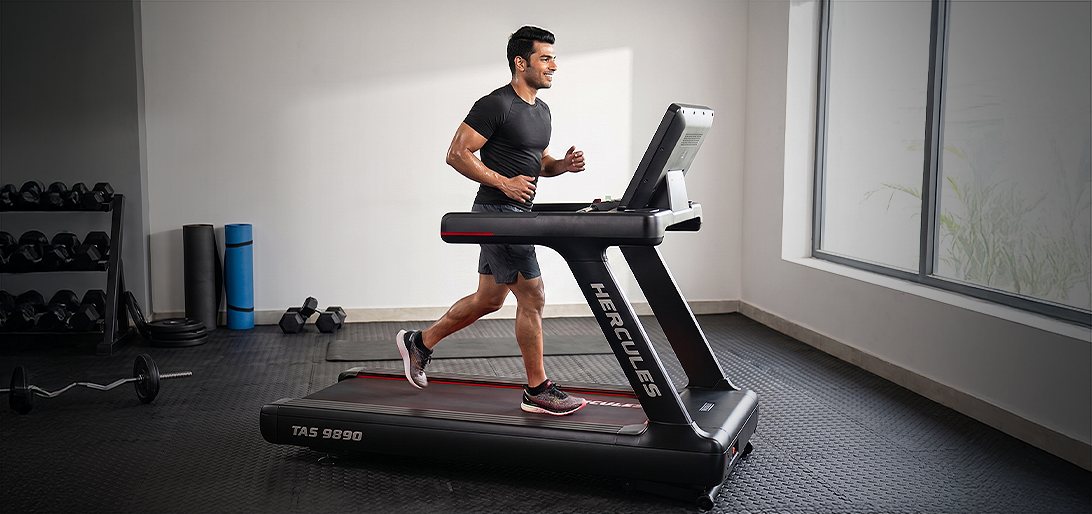
A treadmill does exactly that.
It brings walking, jogging, and running into your own space.
No commute. No waiting. No unpredictability.
You decide when you start.
Early morning before work. Late evening after a long day. Even short sessions in between.
This flexibility is what turns occasional effort into a repeatable habit.
Why the Right Equipment Makes a Difference
Not all treadmills are built for consistent, long-term use.
For working professionals, expectations are higher.
You need equipment that:
- Feels stable and reliable every time
- Supports both light movement and intense sessions
- Adapts to your pace without limitation
- Handles regular use without compromise
Because when something becomes part of your routine, it needs to perform every single day.
Built for Consistency: Hercules Fitness TAS9890A
The Hercules Fitness TAS9890A is designed with this exact purpose in mind.
To make regular movement simple, accessible, and sustainable.
At its core is a high-performance AC motor that supports both steady walking and high-speed running. Whether you are easing into movement or pushing your limits, the transition feels seamless.
With a speed range of up to 25 km per hour, it accommodates everything from recovery walks to intense runs.
The running surface is wide and spacious, allowing for a more natural stride. This reduces discomfort and makes longer sessions more comfortable.
Auto incline functionality adds variation without adding complexity. By simulating uphill movement, it increases intensity and engages more muscle groups within the same time frame.
Designed Around Real Routines
Consistency depends on how easy something is to use.
The TAS9890A is built to support everyday routines, not occasional workouts.
The large touch display gives you clear, real-time feedback on speed, distance, heart rate, and calories. You stay informed without needing to overthink.
The structure is made with heavy-duty steel, ensuring stability and durability over time.
It is built to handle regular use, day after day.
Making Consistency Practical
Fitness results are not driven by occasional effort.
They are built through repetition.
Short sessions done regularly are far more effective than intense sessions done rarely.
When movement is always within reach, you remove the biggest barrier.
Starting.
A Simpler Way to Stay Active
You do not need to overhaul your life to stay fit.
You need to make movement easier to access.
A daily walk. A short jog. A consistent routine that fits into your schedule without disruption.
That is what creates long-term change.
Final Thought
You already know movement matters.
The challenge is making it happen regularly.
When your environment supports that goal, consistency stops feeling difficult.
It becomes automatic.
And once that happens, results follow.
Sometimes, the simplest solution is also the most effective.
You just need to make it easier to begin.